
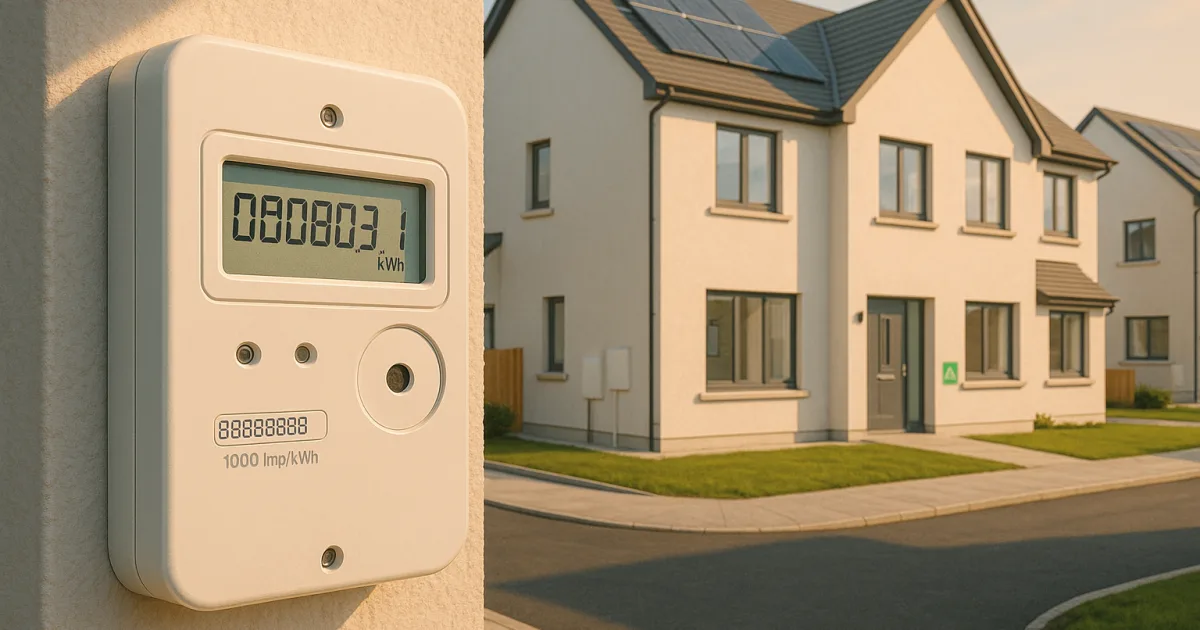
Not all new buildings in Ireland come with smart meters as standard, but the picture is changing rapidly. As ESB Networks continues its national rollout, an increasing number of new-build homes are being fitted with smart meters from the start - and there are strong reasons to make sure yours has one.
The short answer
There is currently no legal requirement for new buildings to have smart meters. However, ESB Networks installs smart meters by default on all new connections since late 2024, meaning most new builds going forward will have one.
Ready to Switch and Save on Your Energy Bills?
Our energy experts at Selectra can help you secure a great rate for your home - completely free.
Ireland's Smart Meter Rollout and New Builds
ESB Networks began Ireland's national smart meter programme in 2019, with a target of replacing all 2.4 million electricity meters by 2025. As of early 2026:
- Over 2.2 million smart meters have been installed across Ireland
- ESB Networks now installs smart meters as the default for all new electricity connections
- The rollout covers both replacements (swapping old meters) and new connections (new builds, extensions)
This means that if your new-build home was connected to the grid from late 2024 onwards, it almost certainly has a smart meter. Older new builds (2019–2023) may or may not have one, depending on when the connection was made and whether the area had been reached by the rollout at that point.
Are Smart Meters Required by Building Regulations?
No. Irish building regulations (Part L - Conservation of Fuel and Energy) set strict energy efficiency standards for new homes, including requirements for BER ratings, insulation, and renewable energy sources. However, they do not specifically mandate smart meter installation.
That said, the EU's Clean Energy Package encourages member states to ensure smart meters are available to all consumers, and Ireland's Climate Action Plan supports the full rollout. The practical effect is that ESB Networks handles meter installation as part of the grid connection process - it's not something the builder chooses.
Key point: The meter type is determined by ESB Networks at the point of connection, not by the builder or developer. If your area is part of the rollout, you'll get a smart meter regardless of whether it's a new build or not.
How to Check if Your New Home Has a Smart Meter
If you've just moved into a new-build property and aren't sure whether you have a smart meter, here's how to tell:
- Check the meter itself - a smart meter has a digital display (not spinning dials). Look for a model number starting with "Landis+Gyr" or "Itron" - these are the two manufacturers used by ESB Networks.
- Check your electricity bill - if your bill shows time-of-use readings (Day, Night, Peak) rather than a single reading, you have a smart meter.
- Log into your supplier's portal - most suppliers show whether your meter is "smart" or "standard" in your account settings.
- Contact ESB Networks - call 1800 928 123 or check ESB Networks online with your MPRN.
What if My New Build Doesn't Have a Smart Meter?
If your new home still has a traditional meter, you can request a smart meter upgrade from ESB Networks free of charge. The process is straightforward:
Request an upgrade
Contact ESB Networks at 1800 928 123 or via their website to register for a smart meter.
Installation appointment
ESB Networks will schedule a visit. Installation takes about 30 minutes and there's no cost to you.
Switch to a smart plan
Once installed, contact your supplier to move to a smart meter tariff with time-of-use rates.
Ready to Switch and Save on Your Energy Bills?
Our energy experts at Selectra can help you secure a great rate for your home - completely free.
Why a Smart Meter Matters for New-Build Homeowners
New-build homes in Ireland are typically very energy-efficient (BER A2 or A3), which means your electricity consumption patterns are already optimised. A smart meter amplifies these benefits:
Time-of-use savings
Shift heavy usage (heat pump, EV charging, dishwasher) to cheaper night/off-peak rates. Savings of €150–€300/year are common for new-build homes with heat pumps.
Solar export payments
If your new home has solar panels, a smart meter is required to earn microgeneration feed-in payments under the Clean Export Guarantee.
Accurate billing
No more estimated bills - smart meters send readings automatically every 30 minutes, so you only ever pay for what you actually use.
Usage monitoring
Track your consumption in near real-time via your supplier's app or the ESB Networks portal, helping you identify waste and reduce costs.