
What Is a Heat Pump Tumble Dryer?
A heat pump tumble dryer is a highly energy-efficient clothes dryer that uses a closed-loop system to dry laundry.
Unlike traditional dryers, which use a simple electric heating element and vent hot, moist air out (vented) or condense it using ambient air (condenser), a heat pump dryer recycles the hot air.
The appliance works much like a refrigerator, but in reverse. It uses a heat pump system - comprising a compressor, evaporator, and condenser - to extract moisture from the air within the drum and then re-heat the remaining air before sending it back in.
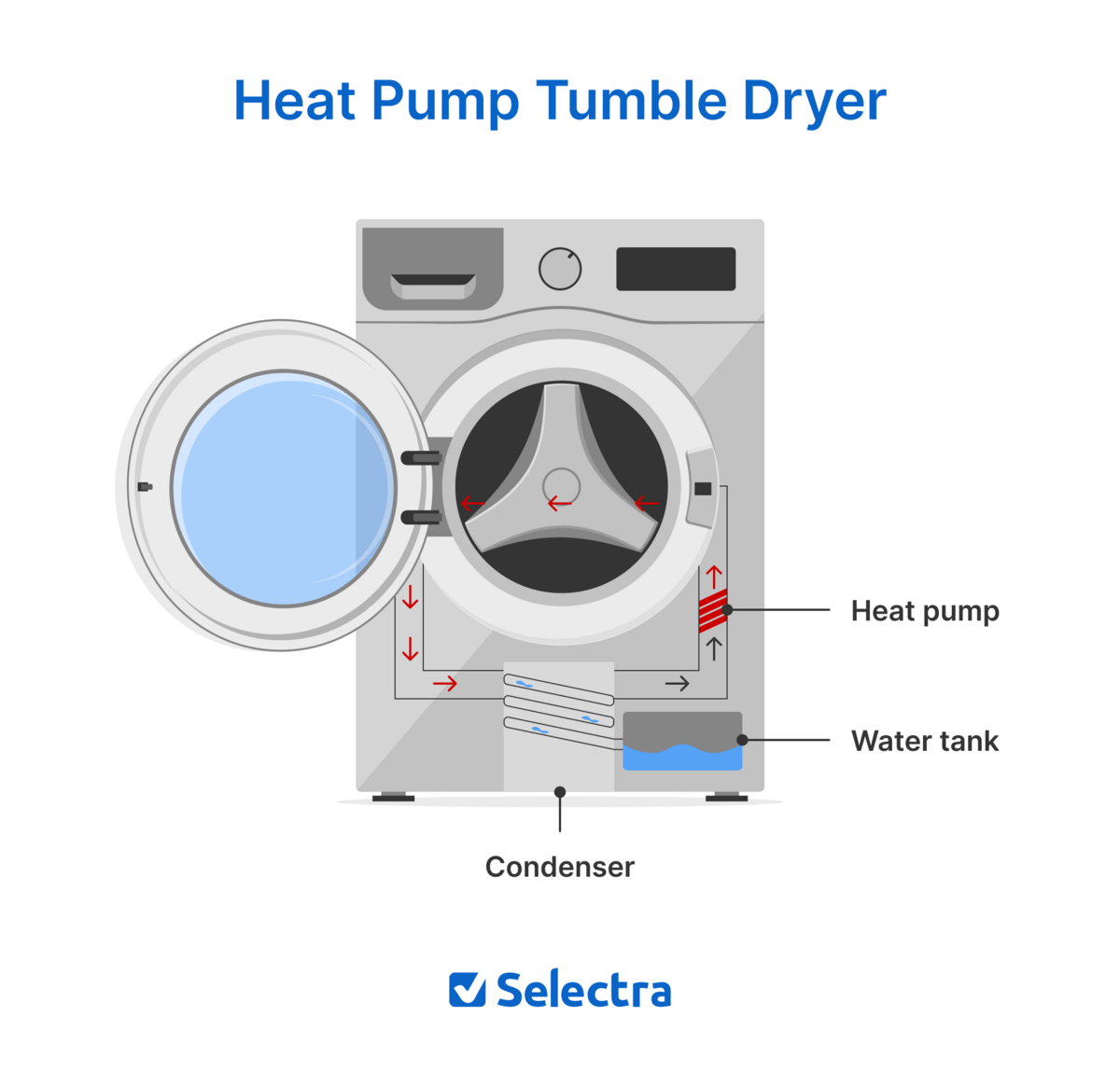
This continuous reuse of the same air means it doesn't need to constantly generate new heat, resulting in significantly lower energy consumption. The drying process also operates at a lower temperature, offering gentler care for your clothes.
Save on Your Home Heating Bills Today!
Our heating experts at Selectra can help you save on boiler services, heat pumps, and home heating oil - for free.
Is It Worth Getting a Heat Pump Tumble Dryer?
The question of whether a heat pump tumble dryer is a worthwhile investment is a common one, and the answer is a resounding yes for most households, especially those that use a dryer frequently.
While the initial purchase price is higher than that of vented or condenser models, the long-term running costs are dramatically lower.
Long-Term Cost Savings
The greatest advantage of the heat pump dryer is its superior energy efficiency.
These models typically have A+ to A+++ energy ratings and can use up to 50% less energy than traditional condenser dryers.
| Dryer Type | Average Energy Use per Full Load (approx.) | Typical Energy Rating |
|---|---|---|
| Heat Pump | 2.16 kWh | A+ to A+++ |
| Condenser | 5.2 kWh | B to C |
For a household running two to three loads a week, the yearly savings on electricity can be substantial.
Over the typical lifespan of the appliance, the savings on utility bills often fully offset the higher initial purchase price, making the total lifetime cost of ownership lower than a cheaper, less efficient dryer.
For environmentally conscious consumers, the reduced energy consumption also translates directly to a smaller carbon footprint.
Benefits for Your Laundry
Beyond the financial and environmental benefits, a heat pump dryer is also better for your clothes. Because it operates at lower temperatures (around 50°C compared to 70°C in a condenser), the gentler drying process helps to:
- Prevent shrinking and damage: Low heat is kinder to delicate fabrics.
- Extend clothing life: Less wear and tear means clothes look new for longer.
What Are the Downsides of a Heat Pump Dryer?
Despite their numerous advantages, heat pump dryers do have a few drawbacks that potential buyers should consider.
Higher Initial Purchase Cost
The most significant barrier is the higher upfront price tag.
The advanced heat pump technology, which includes a complex compressor and heat exchange system, makes these appliances more expensive to manufacture and, consequently, more expensive to buy.
This premium cost can be a deterrent for those on a tight budget, even if the long-term running costs are lower.
Longer Drying Times
Due to the use of lower drying temperatures to maximize energy efficiency, a heat pump dryer generally takes longer to complete a cycle than a traditional condenser or vented model.
While a condenser dryer might finish a full cotton load in about 140–150 minutes, an equivalent A+ rated heat pump model might take up to 200 minutes.
This is a trade-off for the energy savings and gentler drying, and it may require some planning for households that need very fast laundry turnaround.
Maintenance Requirements
To maintain peak efficiency, heat pump dryers require more diligent maintenance, primarily consisting of:
- Regular filter cleaning: The primary lint filter must be cleaned after every use.
- Heat exchanger cleaning: On some models, the heat exchanger unit needs occasional cleaning to prevent lint build-up, which can severely reduce efficiency and increase drying times. However, many newer, higher-end models feature self-cleaning or auto-clean condensers to simplify this process.
Save on Your Home Heating Bills Today!
Our heating experts at Selectra can help you save on boiler services, heat pumps, and home heating oil - for free.
What's the Difference Between a Heat Pump and a Condenser Dryer?
Both the heat pump dryer and the condenser dryer are non-vented appliances, meaning they do not require an external vent hose to expel moist air.
They both collect water in a removable tank that must be emptied. However, the mechanism they use to dry the air is fundamentally different.
| Feature | Heat Pump Tumble Dryer | Condenser Tumble Dryer |
|---|---|---|
| Drying Method | Closed-loop system; recycles and re-heats air using a heat pump. | Open-loop system; heats air with a traditional electric element and then cools it using ambient air to condense moisture. |
| Energy Consumption | Very Low (Most efficient, A+ to A+++) | High (Moderately efficient, B to C) |
| Drying Temperature | Lower (~50°C), gentler on clothes. | Higher (~70°C), more strenuous on fabrics. |
| Drying Speed | Slower. | Faster. |
| Purchase Price | Higher. | Lower. |
The key distinction lies in energy efficiency. The condenser dryer constantly generates and discards hot air, using a lot of electricity.
The heat pump dryer retains and reuses the warm air, meaning the heating element is only required initially and then runs at a very low power, resulting in huge energy savings.
Does a Heat Pump Tumble Dryer Need to be Plumbed In?
No, a heat pump tumble dryer does not need to be plumbed in to function.
Like a condenser dryer, a heat pump dryer collects the water extracted from your clothes in a condensate tank or water reservoir, which is typically located at the top or bottom of the appliance. This tank needs to be manually emptied after each cycle or when a warning light indicates it is full.
However, most models offer an optional drainage hose connection. If you have a suitable drain nearby (such as the drainpipe for your washing machine or a sink), you can connect this hose to allow the water to drain out automatically.
This feature eliminates the need to manually empty the water tank, providing maximum convenience and flexibility for installation anywhere in your home - from a utility room to a kitchen or even a closet - as long as there is a standard electrical outlet.
How Much Does a Heat Pump Tumble Dryer Cost?
The price of a heat pump dryer in Ireland generally correlates with the capacity (usually 8kg or 9kg) and the energy rating (A++ being standard, A+++ being premium), as well as brand.
| Price Tier | Approximate Price Range (EUR) | Key Features |
|---|---|---|
| Budget/Entry-Level | €400 – €600 | Typically A++ rated; basic sensor drying; brands like Candy, Beko, and Hoover. |
| Mid-Range/Standard | €600 – €900 | A++ to A+++ rated; reliable performance; popular models from Bosch, Samsung, and Electrolux. Often includes features like self-cleaning condensers or Wi-Fi. |
| Premium/High-End | €900 – €1,500+ | A+++ rated with maximum features; includes premium build quality and extended warranties from brands like Miele, AEG, and top-tier Bosch/Samsung. |
While you can sometimes find deals or lower-capacity models starting around €350–€400, budgeting at least €600 to €850 will generally secure a highly-rated, feature-rich model from a leading brand.
Top Heat Pump Tumble Dryer Brands
Several brands dominate the Irish market for quality and reliability in heat pump technology. When looking for the best heat pump tumble dryer, you will consistently encounter the following manufacturers:
- Bosch: Highly regarded for their Series 4 and Series 6 models, often featuring an A++ or A+++ rating and self-cleaning condensers for minimal maintenance.
- Samsung: Known for integrating smart technology, such as AI Energy Saving and Wi-Fi connectivity, often paired with A+++ efficiency.
- Miele: Positioned at the premium end, Miele offers excellent build quality, long lifecycles, and superior energy efficiency (A+++), backed by longer warranties.
- Beko & Hoover: Excellent choices for the entry-to-mid-level market, offering good capacity (8kg/9kg) and an A++ rating at a very competitive price point.
- Haier & Electrolux: Other strong contenders offering a balance of features, capacity, and good energy ratings across the mid-range.
Save on Your Home Heating Bills Today!
Our heating experts at Selectra can help you save on boiler services, heat pumps, and home heating oil - for free.
Where to Buy Heat Pump Tumble Dryers in Ireland
For Irish consumers, heat pump dryers are widely available both online and in physical stores.
Major Retailers
- Currys Ireland: Offers a wide selection of brands (Samsung, Bosch, Logik, Miele) and is a key destination for sales and financing options.
- Harvey Norman: Carries a good range of mid-to-high-end models from brands like Bosch, Whirlpool, and Haier.
- PowerCity / Expert Electrical / ElectroCity: These national electrical retailers stock a strong selection across all price points, often providing competitive deals and delivery services nationwide.
Dedicated Home Appliance Stores
Many local and independent appliance stores across Ireland (often affiliated with Euronics) offer personalized advice and frequently stock the major brands (Miele, Bosch, Beko, Hotpoint), sometimes providing local installation services.
Shopping locally can be beneficial for specific service needs and for supporting Irish businesses.
Frequently Asked Questions About Heat Pump Tumble Dryers
Yes, heat pump tumble dryers have a higher initial purchase price than standard condenser or vented dryers because they use more complex, energy-efficient technology (the heat pump system).
However, they are significantly cheaper to run in the long term.
They take longer because they dry clothes using lower heat (around 50°C) to protect fabrics and maximize energy efficiency.
This gentler, cooler process inherently requires more time than the high-heat drying cycles of traditional machines.
This depends on the model. Some high-end models have self-cleaning condensers which require minimal maintenance.
However, many standard models require you to occasionally clean the heat exchanger or filter unit to prevent lint build-up and maintain efficiency.
Look for models with an A++ or A+++ energy rating. A+++ is the most efficient and will provide the greatest long-term savings on your electricity bill.