
What Are Data Centres in Ireland?
Data centres are large warehouses filled with servers, storage devices, and networking equipment that store, process, and distribute data.
Similar to a massive digital filing system, data centres are essential for our daily online lives. They are critical for processing and transmitting data, enabling everything from basic internet services to the recent surge in Artificial Intelligence (AI) tools.
For every WhatsApp message we send, every time we use our banking app, or stream a film on Netflix, a piece of information is produced that must be stored and managed within these facilities.
Ready to Switch and Save on Your Energy Bills?
Our energy experts at Selectra can help you secure a great rate for your home - completely free.
How Many Data Centres Are There in Ireland?
Ireland currently hosts 82 operational data centres, with the vast majority located in the Greater Dublin Area.
As of mid-2025, there are an additional 14 centres under construction, and planning approval has been granted for a further 40 centres.
This represents a potential growth of nearly 50% in the number of facilities, highlighting Ireland's central role in the global digital economy.
Why Are There So Many Data Centres in Ireland?
Ireland remains an attractive location for data infrastructure for several reasons:
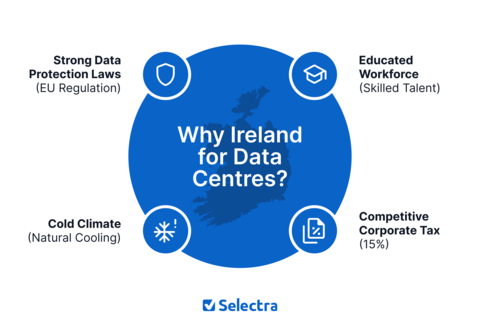
- Competitive Corporate Tax: While Ireland introduced a 15% minimum tax rate for large multinationals in 2024 (in line with global OECD reforms), the standard 12.5% rate remains for many companies. This structure continues to make Ireland a highly profitable base for tech giants.
- Strategic Connectivity: Ireland is a primary landing point for subsea fiber-optic cables connecting the US and Europe, offering the high-speed connectivity data centres require.
- Skilled Workforce: Data centres require highly skilled workers to maintain complex hardware and software systems; Ireland's high percentage of STEM graduates provides a ready talent pool.
- Temperate Climate: Ireland's cool climate allows for natural air cooling, which significantly reduces the energy and costs required to prevent servers from overheating.
Are Data Centres Increasing the Price of Electricity?
While data centres are not solely responsible for high electricity prices, they are significant energy users that place massive demand on the national grid.
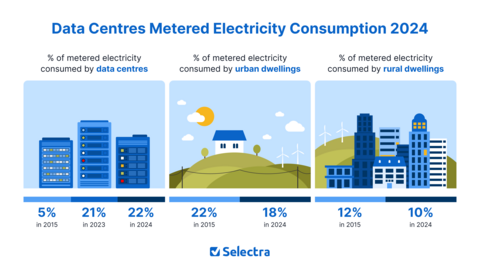
According to the CSO 2024 report, electricity consumption by data centres grew by 10% in just one year, reaching 6,969 GWh.
In fact, for the first time in 2024, data centres accounted for more electricity consumption (22%) than urban homes (18%) and rural homes (10%) combined. Grid operator EirGrid estimates this could rise to almost 30% by 2030.
Are Data Centres Putting Pressure on the Electricity Grid?
The rapid growth of data centres has led to a narrow generation margin, increasing the risk of power shortages during peak times or periods of low wind generation.
While amber alerts were frequent in 2022, the risk has been mitigated recently by the completion of the 500 MW Greenlink Interconnector and new gas-fired "peaker" plants. However, EirGrid still monitors the system closely, especially as Ireland hit a record peak demand of over 6,000 MW in early 2025.
To manage this, the government is investing over €3 billion through 2030 to upgrade the grid. A de facto moratorium on new data centre connections in Dublin remains in place until 2028 to protect local supply.
Moving Towards Sustainable Data Centres
The industry is increasingly adopting "circular" energy strategies:
- Waste Heat Recovery: Projects like the AWS facility in Tallaght now provide low-carbon heat to local public buildings and homes through district heating.
- Renewable Investment: Data centre operators are now major backers of Irish wind and solar farms, funding new capacity through Corporate Power Purchase Agreements (PPAs).
- On-site Flexibility: New 2025 regulations require data centres to have on-site backup generation or battery storage to reduce their reliance on the public grid during peak times.
Ready to Switch and Save on Your Energy Bills?
Our energy experts at Selectra can help you secure a great rate for your home - completely free.
Do Data Centres Impact the Environment?
Data centres currently account for about 2.5% of Ireland's total greenhouse gas emissions. While this is lower than sectors like agriculture, their high electricity usage makes achieving national climate targets more difficult.
Under the Climate Action Plan 2025, Ireland aims for 80% of electricity to come from renewable sources by 2030. In 2024, renewables accounted for 41.3% of supply. The challenge is that as data centres consume more power, the total amount of renewable energy needed to reach that 80% target increases every year.
Are the Government Regulating Data Centres in Ireland?
The Irish government and the CRU (Commission for Regulation of Utilities) have introduced stricter principles for data centre development:
- Grid Flexibility: New facilities must be able to "flex" their demand or use on-site storage during times of grid stress.
- Sustainability Mandates: New projects must demonstrate how they contribute to Ireland's renewable energy and emissions targets.
- Regional Distribution: While the Dublin area faces constraints, the government encourages development in other parts of Ireland where the grid has more capacity.